

It has been a long wait. In 1834, Thomas Davenport demonstrated the first electric car in the UK. Pure electric mobility aids for the disabled (power chairs and 3/4 wheel "scooters") sell at around the million unit level every year and most fork lift trucks across the world are electric. He would be pleased about that. All electric golf cars peaked at about 300,000 units yearly but pure electric on-road cars have yet to sell in more than tens of thousands yearly. Mainly it is a problem of inadequate range from available batteries, lack of charging infrastructure and lack of realistic fast charging. However, there are huge government incentives, new in 2009, to break these logjams. Meanwhile, hybrid gasoline-electric cars will tide us over. Here a big improvement is the availability, from 2009 onwards, of more and more plug in hybrids with big enough batteries to go at least 40 miles on the much cheaper electricity alone if that is your wish, as you save the planet.
See the future of energy harvesting
In all forms of electric vehicle, power management is key and any form of energy harvesting is welcome. The modern car will therefore increasingly use regenerative braking, solar panels outside and maybe the MIT energy harvesting shock absorbers as well. Even those not interested in the automotive industry can learn from its eager adoption of types of energy harvesting because these solutions should also be used elsewhere. Regenerative braking is already commonplace in pure electric cars and coming in with heavy industrial vehicles such as ground support equipment at airports . From 2009, the photovoltaic car roof will increasingly be the norm as well, initially only powering accessories but later, when transparent film solar is available and over the whole car, it will provide significant traction power as well, in sunny countries.
This idea is not new, as evidenced by the 1982 solar powered "car" in Germany.
German solar electric car from 1982 that achieved 15 mph.
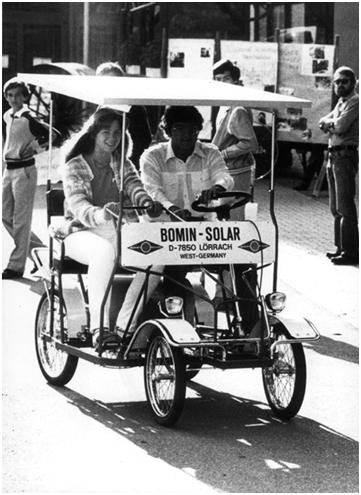
Source German Information Center
The world's largest car company Toyota has a $5 billion electric vehicle business already and IDTechEx projects in its new report Hybrid and Pure Electric Cars 2009-2019 that Toyota's sales of hybrid cars will pass one million in 2014. The global sales of all forms of electric car from all suppliers will be 3.125 million at that time, forecasts IDTechEx. Clearly such volume will be an excellent opportunity for numbers-driven cost reduction of many forms of energy harvesting, benefitting the use of harvesting elsewhere. Is there a place for the new lightweight vibration harvesting to drive accessories for example?
The best selling Toyota hybrid is the Prius. It is the best selling hybrid car in the world by a big margin. Toyota's third-generation Prius appeared this year with an optional solar panel on its roof. The panel powers a ventilation system that can cool the car without help from the engine, Toyota says.
Solar roof on Prius
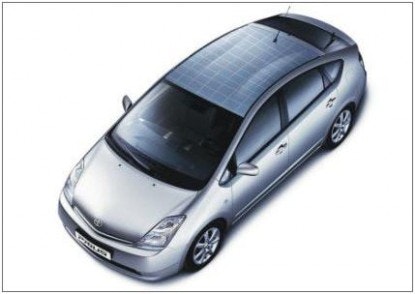
Source Prius
In addition, Solar Electric Vehicles has been offering a solar roof conversion for existing Prius vehicles.
Solar Electric Vehicles $3500 165 W/h Prius solar roof conversion
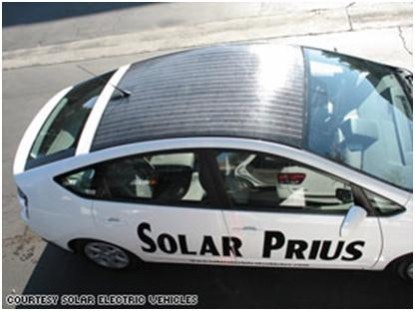
Source Solar Electric Vehicles
Because the Toyota cars are fully crash tested on-road vehicles and currently used solar cells are heavy, the total weight precludes use of solar roofing to drive them along, though getting an extra five to fifteen miles range is not unusual.
"Being able to power a car entirely with solar is a pretty far-reaching goal," said Tony Markel, a senior engineer at the federal government's National Renewable Energy Lab in Golden, Colorado.
In the new Prius, the photovoltaics provides energy for a ventilation fan that helps cool the parked car on sunny, hot days. The driver can start the fan remotely before stepping into the car. Once the car is started, the air conditioning will not need as much energy from a battery to do the rest of the cooling. Although palm sized solar car coolers that fit in the window to cool the parked car have been available for some time, the Toyota roof unit does a far more robust job and the car is more secure because a window does not need to be left slightly open for the gadget below to do its work.
Auto Cool unit, with small polycrystalline photovoltaic panel, clips in a car side window
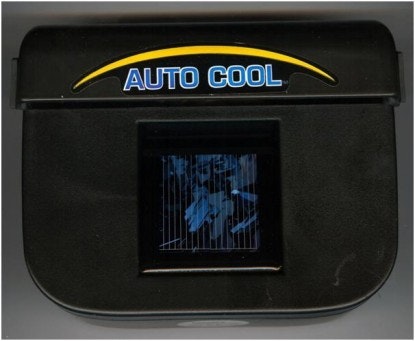
Source IDTechEx
The next stage will be sufficient solar power to run the air conditioning at all times in sunny countries, via battery storage.
"The best thing about using solar is that regardless of what you end up using it for, you're trying to use it to displace gasoline," added Markel.
Japan's Nikkei newspaper reported this year that Toyota hopes to develop a vehicle powered entirely by solar panels. The project will take some years, the paper reported. However, Toyota has not confirmed the existence of such a program.
Solar Electric Vehicles wants to see Toyota bring the weight of a Prius down from 3,000 pounds to 2,000. They expect a small gasoline engine and a larger electric motor for the next plug in versions. Pure electric vehicles are not necessarily lighter because the extra battery weight can offset the saving in weight from dumping the gasoline engine but as more and more have motors in the wheels, dumping the transmission as well, and batteries improve, they will be lighter and more easily powered by photovoltaics. Anyway, someone will sureley use the new flexible "CIGS", "DSSC" or "Organic" photovoltaics to make unfolding or unwinding panels that increase the area harvested during parking. Imaginative design required please.
Top Image source: Solar electric vehicles
For more attend: Energy Harvesting & Storage USA 2009
and
and
