
Rare earth magnets such as NdFeB and SmCo are critical materials used in electric vehicle motors, wind turbine energy generators, industrial robotics and consumer electronics. However, high consolidation of the rare earth magnet supply chain in China has led to years of intensifying market turbulence and disruption. IDTechEx's latest research report, 'Rare Earth Magnets 2026-2036: Technologies, Supply, Markets, Forecasts', forecasts that rare earth magnet supply will exceed 330 ktonnes annually by 2036, with China poised to remain the major global producer over the next decade. Supply risks, growing demand, and national security concerns are fueling government and industry appetite for alternative rare earth magnet supply.
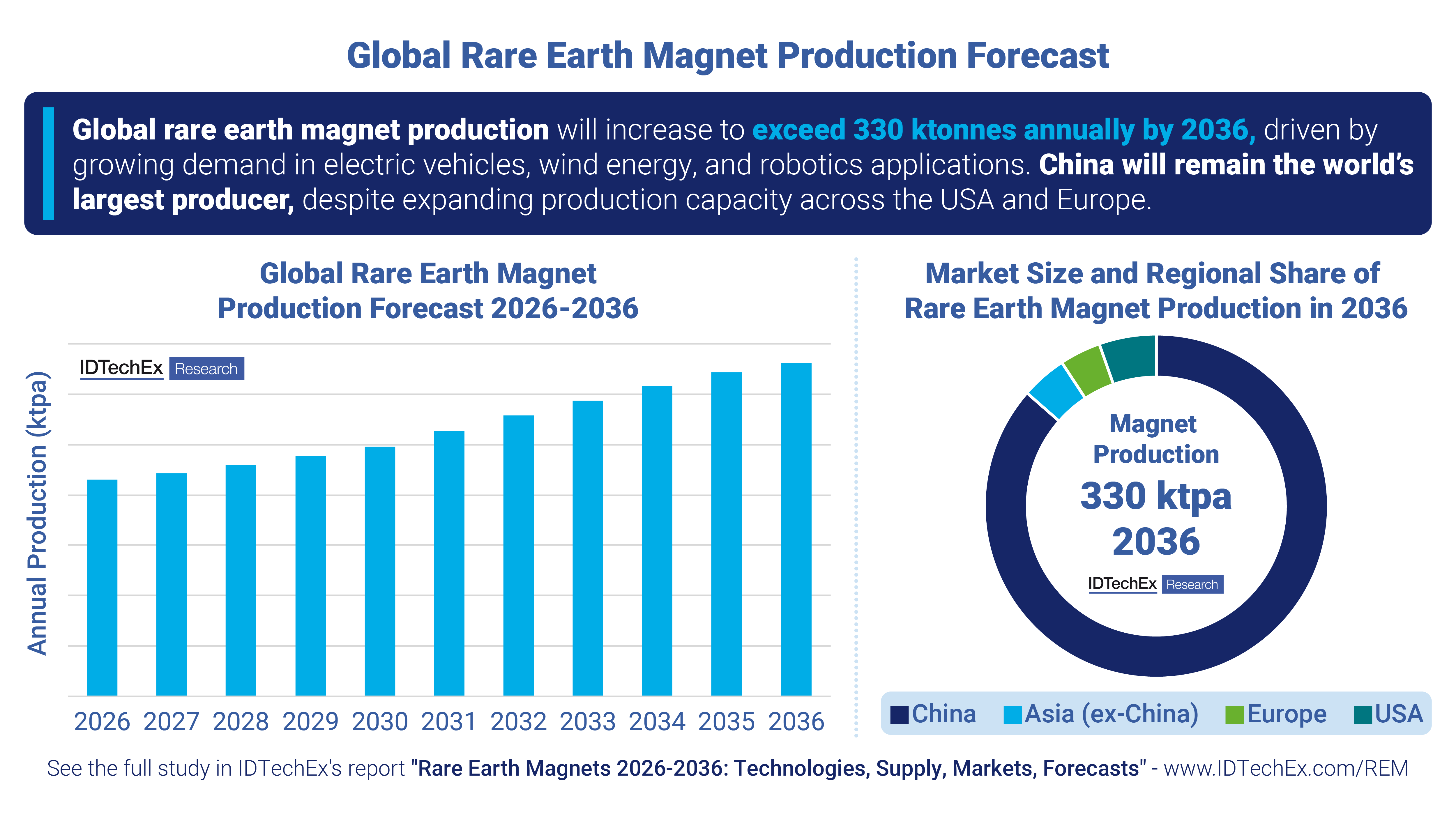
Global rare earth magnet production forecast and 2036 market size and regional share. Source: IDTechEx.
Market developments in 2025 highlight strong market pull for alternative rare earth supply
From trade wars, export restrictions, and now a monumental public-private partnership, 2025 will be a defining year for the rare earth magnet market. Escalating tariff threats between the USA and China generated significant uncertainty in rare earth product sectors reliant on magnet materials. In April 2025, first-of-their-kind export restrictions were imposed by China on NdFeB and SmCo magnet materials, stalling critical material supply to original equipment manufacturers across the world. Market turbulence culminated in the major announcement that the US Department of Defense will provide strategic funding support to North America's largest rare earth producer, MP Materials, through capital investment (>US$400M) and NdPr price floor commitments.
After a year of volatility and uncertainty, the announcement of increased government support could be the catalyst for growth emerging rare earth players have been waiting for. Low rare earth prices in recent years have squeezed margins for new market entrants and established players alike and impacted their competitiveness against market leaders in China. Price floor agreements and risk sharing are highly cited needs for new rare earth supply chains to get off the ground. It looks increasingly likely that more public-private partnerships will emerge downstream, as well as across Europe and Asia, if critical rare earth supply is to be secured in the future.
Rare earth magnets remain best-in-class
Hype around critical rare earth materials centers on rare earth magnets, which are the highest performance permanent magnets on the market in 2025. NdFeB magnets can store over ten times the magnetic energy compared to ferrite magnets and boast superior magnetic strength of up to 1.4 T. SmCo magnets on the other hand demonstrate excellent resistance to demagnetization (coercivity), with operating temperatures of up to 350°C.
Rare earth magnets offer the best strength and power to weight performance for integrated product applications compared to competing Alnico and ferrite materials. With no competition in sight, IDTechEx determines that rare earth magnets will remain the best-in-class high performance magnet technology for the foreseeable future.
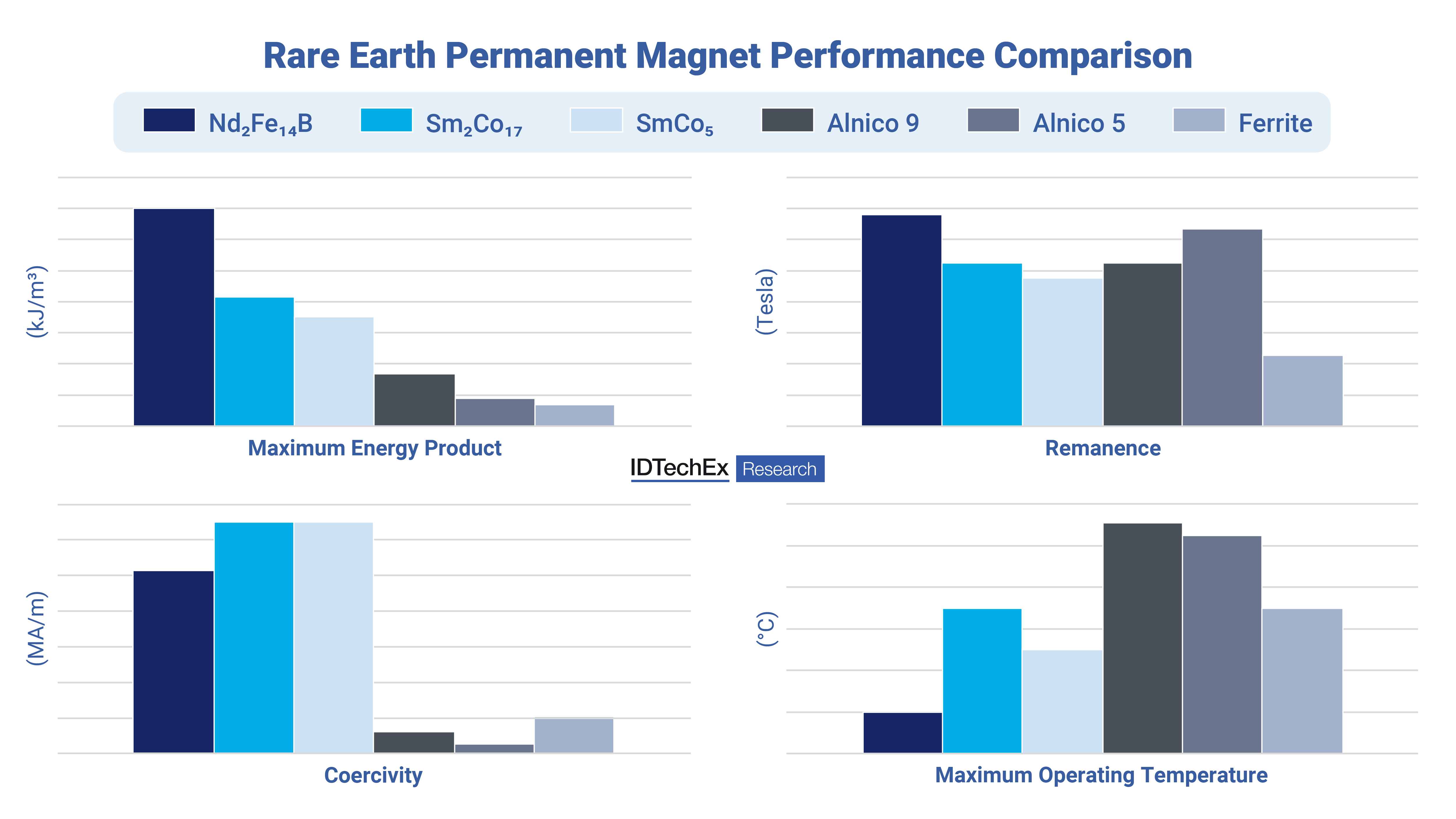
Key performance metrics of rare earth permanent magnet technology compared to competing Alnico and ferrite materials. Source: IDTechEx.
In 2025, rare earth magnet technology trends focus on reducing heavy rare earth content while retaining performance. Grain boundary diffusion, a technology for concentrating metals at magnet grain surfaces, can reduce heavy rare earth content by over 70% and realize an up to 28% reduction in magnet material cost. Rare earth magnet grain engineering technologies are rapidly maturing, with most rare earth magnet manufacturers now using these technologies to improve magnet performance and lower costs.
Rare earth magnet market underpinned by strong demand growth
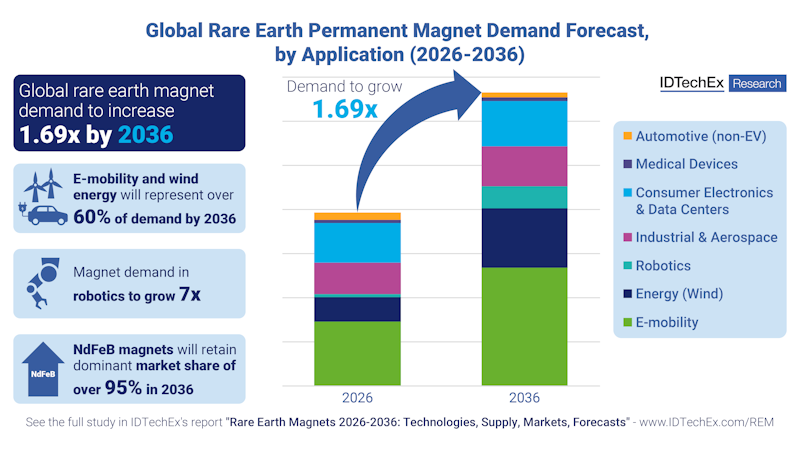
The emergence of new rare earth supply chains and improvements in material performance are driven by growing rare earth magnet demand expected over the next decade. While electric vehicles, consumer electronics, and industrial applications will dominate rare earth magnet demand in 2026, IDTechEx predicts that wind energy and robotics will be high growth applications driving overall magnet demand to increase 1.69x by 2036.
Electrification and decarbonization are key global mega-trends influencing rare earth magnet demand, with e-mobility and wind energy markets expected to represent 60% of demand by 2036. Despite developments in rare earth-free motor technologies, rare earth permanent magnet motors are expected to retain a >70% market share of electric drive motors over the next decade. Increasing demand for rare earth magnets in the wind sector is fueled by sustained growth in global annual capacity installation and average wind turbine capacity. Upwards trends in magnet demand for wind turbine applications are compounded by the increasing adoption of direct drive permanent magnet synchronous generators, which typically require more NdFeB than geared systems.
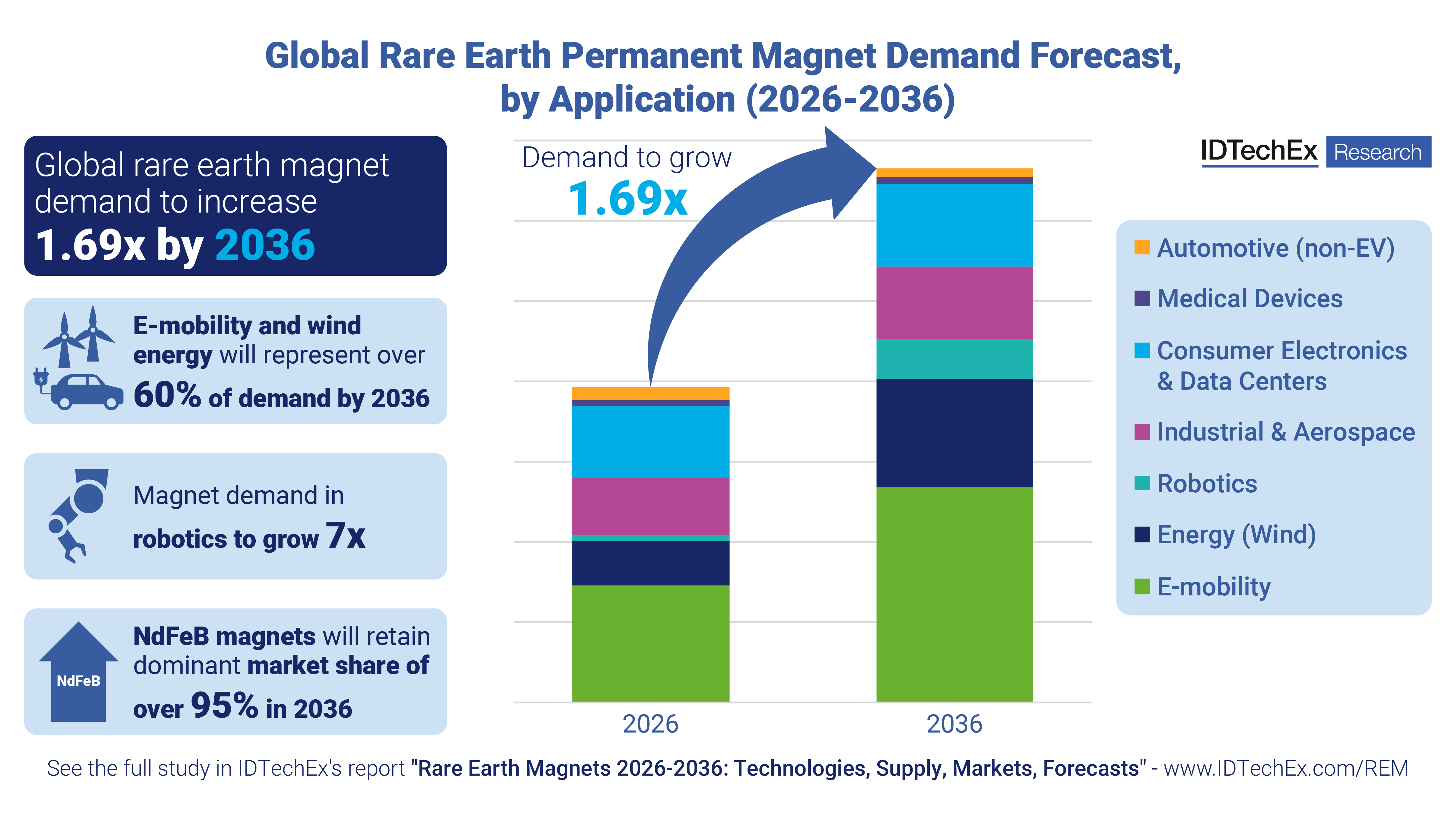
Global rare earth magnet weight demand forecast 2026-2036. Source: IDTechEx.
IDTechEx expects robotics demand for rare earth magnets to take-off in 2025, with humanoid robots a key growth segment. Over 95% of motors used in humanoid robots contain rare earth permanent magnets, where NdFeB magnets are critical for providing high torque density and energy efficiency. Moreover, humanoid robots contain an average of 40 motors per unit, further driving magnet volume demand. IDTechEx forecasts that rare earth magnet weight demand in robotics will increase seven times by 2036, as major adopters such as BYD and Tesla employ humanoid robots in automotive assembly applications.
Outlook for rare earth magnet market beyond 2025
2025 might be the year that supply risks and critical material security concerns realize the expansion of domestic rare earth magnet supply chains that players outside of China have been waiting for. Technology innovations will have a central role to play, with growth opportunities presented for technologies offering scalable rare earth refining, improvements in magnet performance and cost, and effective recycling of valuable rare earths from end-of-life waste.
Despite the improving outlook for emerging rare earth magnet supply and demand outside of China, the limited availability of heavy rare earths will remain a sticking point. Technologies that address heavy rare earths - be that through the economic recovery from mineral concentrates, content reduction in NdFeB magnets, or recycling from waste - will be highly desirable.
IDTechEx forecasts that the rare earth magnet market will grow to US$9.19B in annual revenue by 2036, driven by growing demand in e-mobility, wind energy and robotics applications. IDTechEx's latest research report, 'Rare Earth Magnets 2026-2036: Technologies, Supply, Markets, Forecasts', provides a comprehensive overview of rare earth separation, magnet production, and recycling technologies and critical market analysis. The report contains 10-year granular rare earth magnet supply, demand, and recycling forecasts, by weight (tonnes) and revenue (US$) segmented by region, application and materials.
For more information on this report, including downloadable sample pages, please visit www.IDTechEx.com/REM, or for the full portfolio of research available from IDTechEx, see www.IDTechEx.com.
