

IDTechEx assesses component opportunities in the growing EV battery thermal management market
Despite the drivetrain of an electric vehicle (EV) often being touted as being much simpler than a combustion engine, with fewer moving parts (which is true), the thermal management of an EV can be much more complex, and critical in terms of vehicle efficiency and hence range. The thermal management of EVs brings a host of new opportunities for thermal management components and materials that would not have been seen in the combustion vehicle market. This article, drawing from IDTechEx's report on Thermal Management for Electric Vehicles 2026-2036 takes a deep dive into the thermal management related materials and components in an EV, along with analysis on key trends and players for each.
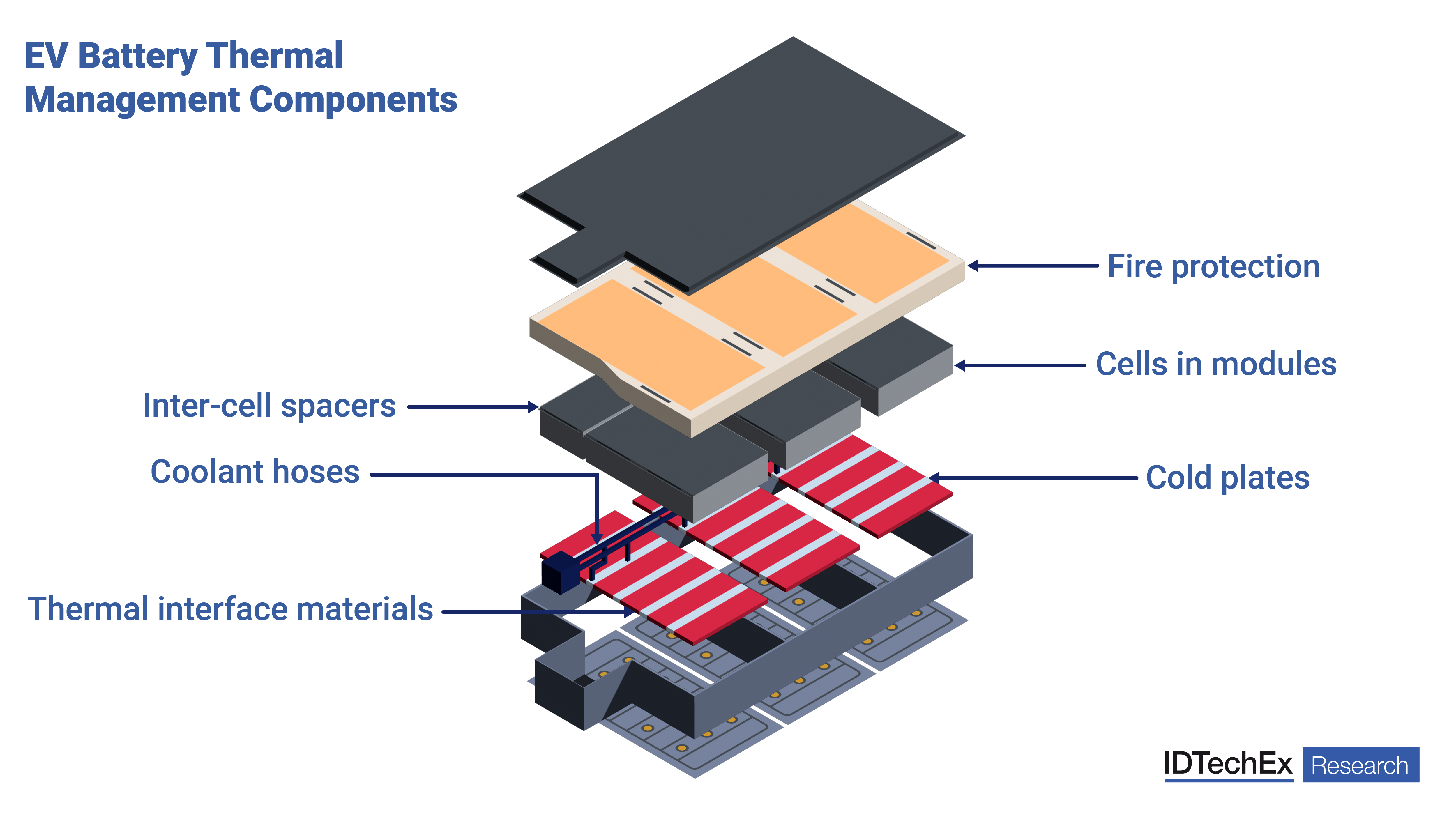
An EV battery pack presents multiple opportunities for thermal management materials and components. Source: IDTechEx
Cold Plates and Coolant Channels Heading to Greater Integration
The majority of the EV market is using indirect cooling with a water-glycol coolant. This requires coolant channels or cold plates to make contact with, and transfer heat to or from the cells. Most use large cold plates that sit below the modules and make contact with the base of the cells.
One key trend is the integration of these plates into the tray of the battery itself, reducing the number of parts, and removing manufacturing steps. However, side wall cooling is one route to improving the thermal homogeneity of the cells. Here, coolant channels (typically made from aluminum) are placed along the sides of cells enabling greater heat transfer at the expense of greater system complexity.
There has also been the development of polymer or flexible coolant channels. These are placed between or below the cells and expand as fluid flows through them, conforming to the cell and eliminating the need for a thermal interface material. Whilst these are not the most widely adopted technology, they offer innovation towards component reduction.
Thermal Interface Materials Bridge the Thermal Gap
To facilitate indirect cell cooling, a layer of thermal interface material (TIM) is typically used between the cells and coolant channels or cold plate. Also between module housings and the cold plate. The TIM helps fill all the small air gaps between the two surfaces and reduce thermal resistance. TIMs are usually made from electrically insulating polymers with thermally conductive fillers.
TIMs can add significant weight and cost to a battery, and hence reducing their quantity is beneficial assuming thermal needs can be met. With this in mind, TIM quantity per battery pack has been reducing somewhat through general design improvements, but significantly through the adoption of cell-to-pack batteries that remove multiple components and hence interfaces that require TIMs. However, cell-to-pack batteries tends to use TIMs that also provide structural adhesion, so whilst the quantity decreases, the performance needs change too. IDTechEx segments TIMs for EV batteries into gap pads, gap fillers, and thermally conductive adhesives, each with their own trade offs and market growth rates. Overall, IDTechEx's report finds a 7.7% CAGR for EV battery TIMs from 2025 to 2036.
Coolant Hoses Require Less Performance
Coolant hoses in an ICE vehicle have to deal with fluids that are above 100°C during normal operating conditions. An EV battery shouldn't be exceeding around 50°C, and the burst pressure of the hoses can be lower too. Therefore, typical ICE coolant hoses may be overengineered for BEV applications.
This is opening the doors for a much greater variety of polymer solutions outside of typical EPDM hoses in order to reduce costs. Polymers such as PA (polyamide), TPV (thermoplastic vulcanizates), and PP (polypropylene) are finding a home in EV coolant lines, with some promoting the use of polymers with bio-based components.
While EVs are heading to more integrated thermal systems, with shorter coolant hoses, an EV still tends to have nearly double the number of hoses compared to an ICE vehicle, combine this with the growing EV market overall, and EV coolant hoses stand to be a large growth opportunity.
Multi-functional Fire Protection
EV thermal runaway and fire safety is of critical importance, and regulations are pushing towards stricter targets. China's GB 38031-2025 standard, set for implementation in July 2026, sets a requirement for no thermal runaway propagation for two hours after initiation of thermal runaway in a single cell. Fire protection materials can be placed at various locations within a battery pack including between the cells, over the modules, below the lid, etc. Each depends on the protective strategy taken and the fundamental battery design.
With such a broad set of potential material requirements, there is a large range of materials that could be applied, from ceramic blankets, to mica layers, aerogels, and many more. As automakers try to reduce the cost of their battery systems, having fire protective materials that can also serve other functions such as electrical insulation, compression performance, thermal insulation, or several others, can provide a significant benefit in overall material cost and assembly efficiency.
Despite serving the same application, in the same growing market, each material category that IDTechEx covers has a different growth rate with the summation exhibiting a 15% CAGR from 2025 to 2035 according to IDTechEx's Fire Protection Materials 2025-2035 report.
Integrated Thermal Management Modules
The thermal management system in a BEV has to consider several components and how they all interact. The passenger cabin, battery, motor, and a host of electronic components all require cooling, heating, or transferring heat between them. This can lead to a large number of thermal components such as pumps, valves, heat exchangers, compressors, and chillers spread throughout the vehicle.
One key trend is to combine multiple of these components into a single integrated thermal management module (iTMM). This allows the OEM to purchase a single component rather than several whilst maintaining performance and functionality. As well as these being supplied from tier 1s, OEMs are increasingly getting involved in this space to optimise them for their own use cases. OEMs like VW and Hyundai have already announced iTMMs developed in-house.
How to Keep Up With Trends Across These Markets
Across the variety of materials and components in the EV market, there are trends relevant for each of them, and there will be an impact from the wider EV market, regulations, and regional disparity. IDTechEx's report on Thermal Management for Electric Vehicles 2026-2036 looks at these components and materials, with trends, players, and an outlook for the future. Additionally, IDTechEx's subscription platform allows for more regular and granular updates on trends, data, event summaries, and the potential to talk to their analysts one-on-one.
For more information on this report, including downloadable sample pages, please visit www.IDTechEx.com/TMEV, or for the full portfolio of thermal management related research available from IDTechEx, see www.IDTechEx.com/Research/Thermal.
