

With the mining industry transitioning from diesel to electric machines, this article highlights the key drivers that will further machine electrification, the key challenges that have hampered adoption to date, and the direction the market may take over the next 20 years.
Over the last 5 years, the global market for mining machines has seen considerable evolution, as decades-old machine technologies are disrupted by the prospect of electrification. Machine manufacturers, mining companies, and governments are now increasingly aligned in their aim of electrifying the mining industry, leading to greater implementation of electric machines in mines today. While the market still faces challenges that will need to be addressed in the coming years, IDTechEx's new "Electric Vehicles in Mining 2027-2047: Technologies, Players, Forecasts" report details how the global market for electric mining machines is forecasted to grow to over US$27 billion by 2047.
What is driving the adoption of electric machines?
With increasing attention being paid to decarbonization and sustainability across global sectors, the mining industry has also come under greater scrutiny. Mining accounts for 2-3% of all global greenhouse gas emissions, with over half of this coming from the direct emissions of diesel mining machines. Therefore, their electrification will go some way towards reducing global emissions and help countries to achieve their sustainability targets.
On top of their environmental credentials, electric vehicles (EVs) can facilitate operational benefits too. They produce far less heat, noise, and vibration than diesel combustion engines, creating a cleaner and safer working environment. The lack of direct tailpipe emissions also benefits working crews, especially when working underground, and drastically reduces the requirement for expensive and power-hungry ventilation systems. Additionally, EVs have fewer moving parts and less frequent need for repair, while also not consuming any energy while idling or stationary.
However, the most significant driver leading to electrification in mining is the financial benefits that EVs can offer over diesel. This comes largely through the use of cheaper electricity, with savings able to compound quickly due to the high rate of utilization of many machines (including up to 24/7 operation). IDTechEx's new report finds that, even though electric machines will come at a greater upfront cost, the savings generated through energy costs are more than sufficient to overturn this and make EVs financially favorable on a total cost of ownership (TCO) basis. This is before other sources of savings are considered, such as reduced maintenance costs and improved drivetrain efficiency.
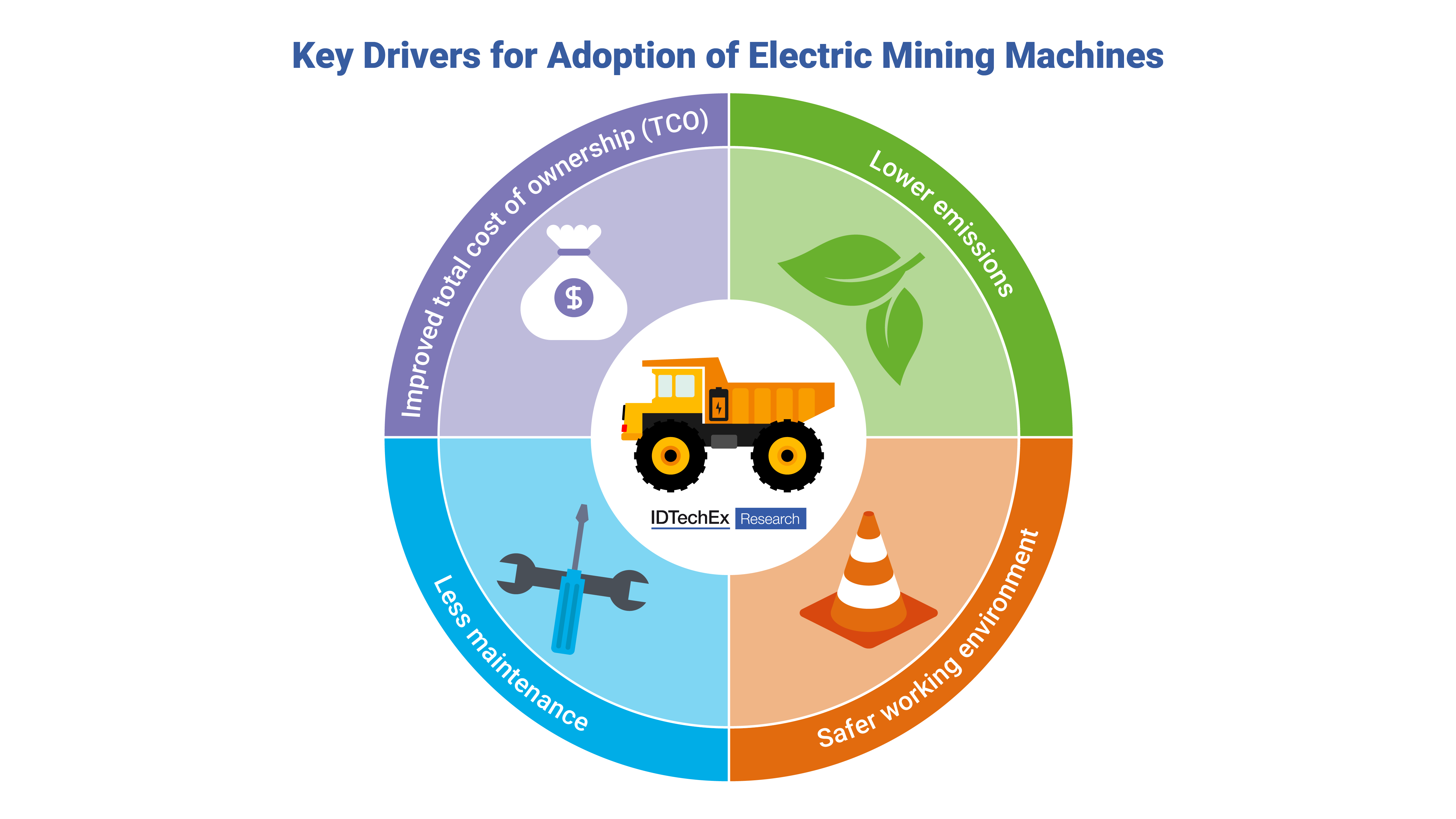
Adoption of electric mining machines is driven by environmental, operational, and financial benefits. Source: IDTechEx
What roadblocks are EVs facing?
In spite of all the development that has taken place in machine electrification in the last 5 years, the industry still faces considerable technical and market factors that are hampering adoption. In particular, the high utilization rates of mining machines pose significant challenges for both the battery technologies and charging systems used in mining. Most machines are now equipped with batteries large enough to enable around 6 hours of continuous operation before they need to be recharged. This is the result of significant developments made by machine manufacturers in recent years to improve runtimes, but it remains far from the near-constant operation that mining companies are accustomed to with existing diesel equipment. To enable the productivity enhancements that mines demand will call for a combination of larger battery packs, more energy-dense battery technologies, and faster charging systems to minimize downtime.
Charging in itself poses a challenge for many mines, with those in remote locations often having poor or inconsistent grid access to enable fast charging. Future widespread adoption of EVs in mining will increase electricity loads substantially and demand upgrades to on-site electrical infrastructure. This may include solutions such as BESS installations or microgrids in the longer term.
At a legislative level, while governments are interested in the decarbonization of mining activities, there has been little regulation to date that is specifically targeted towards the electrification of mining machines. Canada is the only country to have done so, while other regions including China, India, and Australia have catch-all policies targeted at mobility more broadly which have led to some electrification in machines. Crucially, the US has a large mining industry but no regulatory framework to encourage EV adoption in it.
What does the future hold for electric mining machines?
Electric machines have already proven their capability to provide environmental, operational, and financial benefits to mines, leading to growing rates of adoption into mining fleets. This adoption is expected to accelerate over the next 20 years as OEMs continue developing vehicle, battery, and drivetrain technologies and as charging infrastructure becomes optimized for the mining environment. Crucially, adoption is likely to be driven less by regulatory pressure and more by the independent adoption of EVs by mining companies.
The maturation of the battery industry will also be key to growth, allowing large MWh-scale batteries to become more commonplace in the largest electric mining trucks and helping to prolong runtime and improve machine productivity. As battery innovation continues, the falling prices of Li-ion battery packs are expected to make their way into mining, reducing the upfront price premium that EVs come at and potentially growing their adoption further.
IDTechEx's market outlook
IDTechEx's "Electric Vehicles in Mining 2027-2047: Technologies, Players, Forecasts" report goes into additional detail on all of these factors and more, highlighting how the global market for electric mining vehicles is set to grow to over US$27 billion by 2047. The myriad benefits that EVs offer on mines coupled with continuing technology development, including for batteries and charging, will be key drivers for their adoption and the growth of the industry.
The IDTechEx report dives deep into key drivers and barriers for adoption, provides benchmarking and case studies of state-of-the-art machine models from key OEMs, financial analysis of machine TCO, and in-depth technology appraisals of batteries, charging systems, motors, and inverters. Granular 20-year forecasts are provided for global mining EV sales (in 1000s of units), battery demand (in GWh), and market size (US$ billion), segmented by region (USA, Canada, Europe, China, Australia, Rest of the World) and by machine type (haul trucks, dump trucks, wheel loaders, underground loaders, underground trucks, mining light vehicles, other mining vehicles).
For more information on this report, including downloadable sample pages, please visit www.IDTechEx.com/EVMining, or for the full portfolio of related research available from IDTechEx, see www.IDTechEx.com.
