

You have to listen to the world leader in electric vehicles, Toyota, because it pulled even further ahead of number two in the last year. Its hybrid car sales nearly doubled to about 1.32 million units in 2011, more than all other hybrid cars put together. In Japan, 25% of cars sold are now hybrids and Toyota sells 60% of them. It also sells hybrid forklifts, buses etc and is world leader in all-electric forklifts.
"Hybrid on-road vehicles are what is demanded for the next ten years, so there is no need for charging stations," was the message of a Toyota presentation at Automotive World EV Japan Conference in Tokyo last week. Toyota argued that, of the electric cars that will sell in volume over the next decade, only the plug-in hybrid needs plugging in and that will be to a household socket overnight.
That is pretty shattering stuff given that interested parties such as national and local government, Nissan and power generating giants say they will financially support about one million charging stations going in worldwide over the coming decade. However, seeming to support Toyota, we heard a new reality from one of the leading charging station manufacturers in the exhibition that only 5000 fast chargers will be installed in Japan over the next five years. In the conference, the Institute for Information Technology said it had just slashed its global forecast for pure electric on-road vehicles from 4.5 million units sold in 2020 to a mere 1.3 million. It reported that the Mitsubishi MiEV had not increased sales through 2011 above a trickle of 450 or so per month, though the Nissan Leaf, production-limited for most of the time, was at quadruple that number for many months. It seems that IDTechEx may have been right to heavily discount the announced external charging station forecasts in its report, Electric Vehicle Charging Infrastructure 2012-2022 . Volkswagen claimed that the typical 160 km/100 mile range pure electric cars has half that range on a motorway so they must not be taken on motorways, so there is a picture emerging here.
Some other sound bites give remarkable insights, such as that from arch proponent of pure electric cars, Nissan, which is progressing Infinity Hybrids: "Nissan is rather late to develop hybrids."
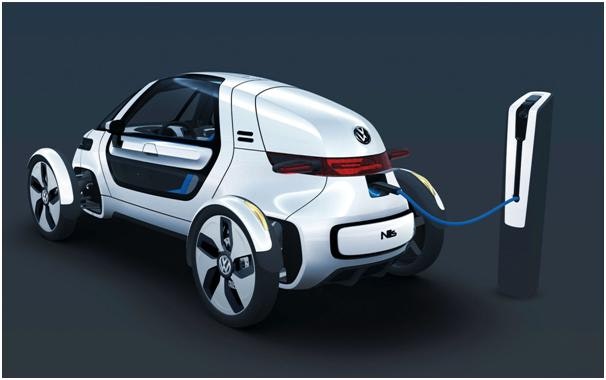
Source: Volkswagen
There is disagreement about the mix of hybrids between plug-in versions and those that do not plug in - some calling those mild hybrids. Speakers from Bosch and Ford gave the traditional view that, even in 2020-22, most hybrids made will not plug in, indeed, the plug-in percentage is still seen as tiny. This is in contrast to Toyota's headlong rollout of plug-in hybrid versions of all models and it was interesting that the Institute for Information Technology speaker showed a more positive trend, his revised figures showing hybrid on-road vehicles being 45% of all hybrids, up from 44% in the previous forecast. Volkswagen said "Plug-in hybrids are the way to go", pointing out that the battery price problem is neatly sidestepped by only 12 kWh being typically needed.
Expect some future forecasts to put plug-in hybrids at the majority in 2022, if only because that is what owners really want so they can enjoy much cheaper "fuel" by extensive use of the all-electric mode which will have much more range by then as Toyota promised. Indeed, IDTechEx forecasts 88% of electric cars sold worldwide in 2022 will be hybrid and the vast majority of these will be plug-in. By then, aggressive players will offer plug-in at no extra cost. See the IDTechEx report, Electric Vehicles 2012-2022 for more detail. Automotive manufacturers not keeping up with this will be in trouble.
Less important, there is still confusion in terminology. In the USA, many people still think an EV is a car rather in the way they called a radio a transistor in the 1960s. That will change. GM has added further confusion by ignoring the conventional understanding that hybrids are vehicles with a second, substantial on-board source of power to wheels or battery.
The GM presentation unhelpfully talked of Range Extended Electric Vehicles REEVs as different from hybrids when they are really a type of hybrid. REEVS were defined as pure electric vehicles in basic design but with a modest extra source of power, typically just to charge the battery. The Volt was counted as an REEV. This is rather wide of the mark because, although it may have started on the drawing board as a series hybrid with a big battery and small internal combustion range extender to charge that battery, it is now one of the more complex hybrids with a large conventional engine and three clutches operating a form of series parallel configuration. This makes no judgement about potential commercial success. After all, the all-conquering Toyota Prius is a very complicated form of hybrid as well. It will be interesting to see Volt sales in 2012 when production has caught up with demand and global rollout of clones is fully under way. The Volt is unusually roomy and has unusually good all-electric range for a hybrid car. In the conference, there was an emerging consensus that the sweet spot for hybrids is the larger cars being launched by Volkswagen, BMW and many others, not the tiny Toyota Auris now being produced in the UK for global sales or the Honda Fit with its poor sales.
Never underestimate the energy and coordination of the German state machine in working to catch up and overtake in electric cars, with huge collaboration between research institutes, technical universities and its vibrant motor industry. One speaker noted that the Germans will be particularly aggressive in the race ahead. The Volkswagen speaker was very frank in admitting that all its electric vehicles have been a failure so far, but many born electric versions - VW, Audi and Porsche - are on the way, particularly addressing issues of affordability.
A footnote to all this is the market for premium priced pure electric cars of good range, so admirably addressed by Tesla with the Roadster. The Toyota speaker said, "We admire everything about it but the price". The Tesla Model S family car is eagerly awaited and we heard that the order book is 1500 and rising. Tesla say they will abandon the Roadster and its sales certainly seem to have peaked. Expect Tesla investor Toyota to value engineer something similar with its huge in-house access to latest motors, batteries, inverters and the like. Not that any such announcement has been made ......
For more attend Electric Vehicles Land Sea Air USA 2012 ,where uniquely we reflect the new realities that there are now six key enabling technologies and they are competing in all forms of EV, hybrid, pure electric and land, water and airborne, manned and unmanned. Speakers from ten countries detail the situation in their parts of the world including SNYPER 3 from Singapore, first to fly an electric helicopter recently, showing how 40% of helicopter crashes could be avoided with hybrid electric technology. Sun Yat-Sen University China and Germany Trade & Invest detail their national situations. Next generation batteries are covered by Robert Bosch (Bosch Group) of Germany, Oxis Energy UK and speakers from Canada and the USA. OLEV Technologies will show how to continuously pick up power, Schneider Electric of France how modern charging infrastructure is a system not boxes. There will be two presentations on supercapacitor breakthroughs - here is the future. See the full picture, with best-in-class speakers from across the whole world - Slovenia to Gibraltar, China to Canada, each carefully chosen by IDTechEx because of their leadership. There are two presentations on agricultural EVs and four on electric aircraft including Boeing and Airbus involvement. Other presenters include BMW (cars etc), Mitsubishi Motors (small commercial vehicles and cars), Daimler AG (commercial and military vehicles and cars) and Toyota (leader in electric forklifts, cars, buses but also presenting on its fuel cell vehicle program.) Uniquely, a large number of electric vehicle manufacturers not seen in conventional EV events will present including iRobot Corporation Autonomous Underwater Vehicles AUVs (better known for EVs as robot vacuum cleaners). Mission Motors and two others focus on electric motor cycles. Many manufacturers of industrial, commercial, military, cars and other EVs will be there. Come to this event where you avoid the usual speakers with nothing new to say and meet people new and useful to you without doing a lot of travelling to find them. Apply for an award.
