

Range extenders
Tata Jaguar Land Rover has observed that hybrid and pure electric vehicle technology will converge in the form of long range vehicles with tiny range extenders that are not internal conventional combustion engines as used in today's "legacy thinking" hybrids.
True, Lotus in the UK has developed a tiny "range-extender engine" but this 124 pound "monoblock" engine is still an internal combustion engine with the limitations of fuel choice, reliability etc that that implies. It implements numerous money and weight saving features that could make extended-range hybrids even more appealing in the future. The block, cylinder heads, and exhaust manifold have all been built into a single, lightweight casting. This sheds weight and 17 parts.
Ultra light weight range extender
To leapfrog that, a consortium led by micro gas turbine company Bladon Jets Ltd recently secured investment from the UK Technology Strategy Board to develop an Ultra Lightweight Range Extender (ULRE) for next-generation electric vehicles. Total project cost is £2,206,784, with the TSB providing £1,103,392 (US$1.8 million). Here again there is a monoblock approach to reduce the number of parts and cost plus improve reliability and weight but you only have to look at a jet aircraft to realise that turbines take us into a whole new realm of reliability and fuel versatility.
The Bladon Jets microturbine range extender is the size of two cans of beans
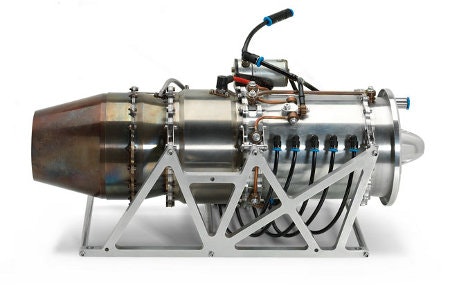
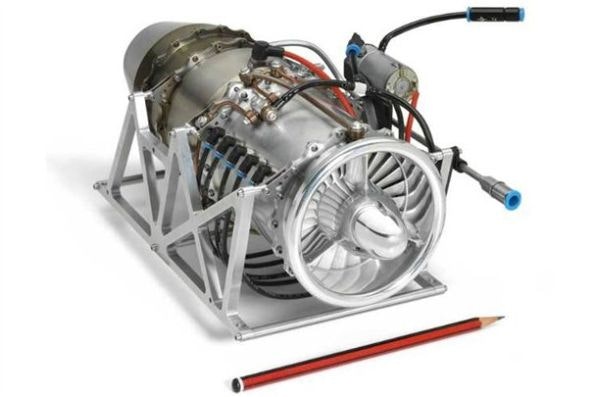
Source Bladon Jets
The objective of the consortium, which includes luxury car maker Jaguar Land Rover and leading electrical machine company SR Drives is to produce the first commercially viable gas turbine generator designed specifically for automotive applications.
The ULRE will incorporate a Bladon Jets patented, axial flow gas turbine engine coupled to a high-speed generator utilizing SR Drives' proprietary switched reluctance technology. Design of the ULRE's packaging for vehicle integration will be overseen by Jaguar Land Rover, which has earlier organizational experience with automotive turbines. Rover produced a series of gas turbine cars in the 1950s and '60s. The experimental Jet 1 caught the public's imagination, reaching a top speed of 152mph but it proved difficult to build a jet engine small enough to fit in a car, and fuel efficiency was poor. Jet 1 also suffered from slowness to respond to the throttle. It, and the similar later attempts by other car companies, failed because of size, cost and other factors that can now be addressed with modern technology if the turbine is not driving the wheels, but is simply charging the traction battery.
Bladon Micro-Jet Engines are 100% axial-flow, gas turbine engines for use in a variety of applications. Key features include:
• High efficiency multistage axial-flow compressor
• Clean burn annular combustion chamber
• High temperature axial flow turbine
• Oil-less carbon-air bearing system
• One moving part (shaft and blades made in one piece)
Bladon suggests that in a hybrid vehicle application, with no water-cooling system, oil or catalytic converter, its Micro-Jet engine can provide vehicle weight savings of up to 15%—with a consequent reduction in fuel consumption and carbon emissions—compared to a piston engine. Further environmental benefits will be gained from its fast warm up (a few seconds, as opposed to several minutes for a conventional engine), cleaner combustion and lower manufacturing energy requirements, the company says.
One prototype—the BJ-300-P—weighs 4 lbs, is 4 inches in diameter by 12 inches in length, and delivers 27 lb (120 N) of thrust. With 90,000 rpm, the prototype features a 5-stage axial flow compressor and a 1-stage axial flow turbine.
Bladon Jets' patented manufacturing process enables the production of axial-flow compressors and turbines in smaller sizes than has previously been possible and can be used to bring about improvements in performance, efficiency and reliability of any size of gas-turbine engine or turbo-molecular pump, according to the company. In addition, the process significantly reduces the development time and manufacturing costs for new engines.
One piece integrally-bladed turbine components can be manufactured in virtually any profile, with varying section, edge radii and taper from root to tip and from any metal/alloy (including: aluminium alloys, nickel alloys, stainless steel and aerospace grades of titanium). Improved performance and efficiency is achieved by closer tolerances and reduced hub to tip ratios. Improved reliability is due to stress free machining from solid material and reduced inertial mass.
Paul Barrett, co-founder and chairman of Bladon Jets, says: "Successful miniaturisation of the axial-flow compressor has been the key to what we are doing. We've now got the blisk down in size to 40mm diameter, although 75mm is the optimal size for our prototype engine. Ultimately, the axial-flow design enables higher efficiencies from the compressor, and allows more stages to deliver higher pressure ratios. This provides an advantage over traditional centrifugal compressors. One of the major problems with early gas turbine powered cars was turbine lag, creating a one- to two-second delay from stepping on the throttle to the car accelerating. Early models also suffered poor fuel efficiency at low speed and idle. Barrett says that the advent of all-electric drive in a serial hybrid electric vehicle overcomes both these problems. Electric motors provide considerably more torque, and hence acceleration, at low revs than even a piston engine and a gas turbine driven generator can be operated continuously at its optimum speed - with any excess power being used to charge the vehicle's batteries. As a result, the gas turbine is allowed to run at its most efficient operating point."
The basic switched reluctance SR Drive system comprises a simple brushless motor with a dedicated electronic controller. Torque is produced by the magnetic attraction of a steel rotor to stator electromagnets. No permanent magnets are needed, and the rotor carries no "squirrel cage" or windings. Properly designed and controlled, the SR motor can yield high efficiency across a very wide range of load conditions.
The SR Drives Group, which participated in the TIGERS project is based on a single site in Harrogate UK and comprises two operating companies: Switched Reluctance Drives Ltd (SRDL), and SR Drives Manufacturing Ltd (SRDML). Both companies are wholly owned subsidiaries of Emerson Electric Co of St Louis, Missouri—the world's largest manufacturer of electric motors.
SR Drive has engaged in several hybrid drive projects in the past, including collaboration with Green Propulsion, a Belgian company, to develop two switched reluctance motor-generators for a hybrid power-train project designed to cut carbon emissions in vehicles such as buses and waste collection vehicles.
Backing for the project was secured in a £15-million funding competition organized by the Technology Strategy Board to support the advancement of the mass adoption of low carbon vehicles and is a key part of its wider program to stimulate technology-enabled innovation and to help boost UK growth and productivity.
All this puts Tata motors up with and probably ahead of others preparing to supply microturbines as next generation EV range extenders. For example, in mid-2009, Israeli startup ETV Motors Ltd. (ETVM) completed a proof-of-concept test of its Range-Extended Electric Vehicle (REEV) architecture using a gas microturbine for the range-extending generator. The company had closed a $12M Series A round in April 2009. The Audi A1 hybrid has a tiny Wankel engine as a range extender but it is only a concept car as yet. So far, Wankel engines have been a big failure while jet engines are a big success. Reliability has been one reason. The University of California Davis analyses hybrid future scenarios.
For more attend Future of Electric Vehicles which uniquely covers the whole electric vehicle market - land, sea, air whether hybrid or pure EV - with emphasis on future breakthroughs.
