
Remote monitoring has several advantages of interest to managers of large battery deployments.
The market for remote battery monitoring is expected to continue to grow over the next decade, fueled by demand from mobility and energy storage system managers. This trend is tied to increasing interest in wireless battery management systems (wBMSs) to save on wiring costs and reduce battery pack complexity, though the majority of the market will continue to be made up of wired BMSs using gateways to convert to wireless communications protocols. The IDTechEx report, "Advanced Battery Pack Sensors and Remote Monitoring 2026-2036: Technologies, Markets and Forecasts", offers further information.
Remote monitoring has several advantages of interest to managers of large battery deployments. First and foremost, it allows for the extraction and deeper analysis of battery pack measurements, including voltage, current, and temperature. The BMS alone is not capable of advanced state of health (SoH) and state of charge (SoC) monitoring; however, by extracting the data and analyzing through a more powerful computer terminal, using, for example, machine learning methods, better modelling can be performed.
Secondly, remote control can also be achieved, in which the centralized computer essentially acts as a more powerful BMS for a number of packs at once. This allows for the implementation of more efficient strategies, for example in charge-discharge protocol optimization and cell balancing.

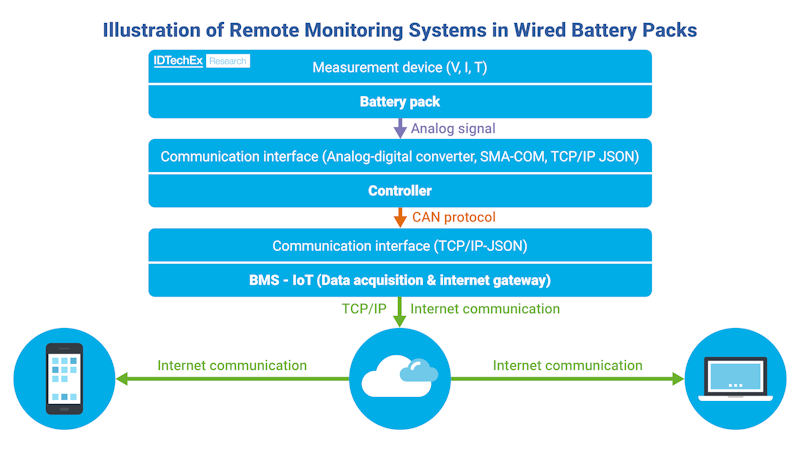
Remote monitoring processes in wired battery packs. Source: IDTechEx
Comparing existing BMS communication protocols
The communication protocol used in a battery pack describes the form and method by which data is transmitted from different electronic components, including sensors, microcontrollers and the BMS chip. Most BMSs use wired communication protocols, i.e. components must be directly wired into the battery management system. This can be expensive, but ultimately wired communication protocols are reliable, secure and have a high data rate.
Of the wired communication protocols, the most popular for automotive applications is the controller area network or CAN. The CAN-bus is a two-wire bus that acts as the central nervous system of the BMS. All components are connected to the bus, via an electronic control unit (ECU), which is formed of a microcontroller, CAN transceiver and CAN receiver. Data from the bus is received and sent through the ECU, which then determines whether this data should change the operation of associated components.
Wireless architectures are currently niche, though becoming more popular. Under a wireless architecture, instead of communicating through the bus, ECUs would communicate via wireless communication, e.g. Bluetooth Low Energy (BLE), Zigbee or a proprietary protocol. The advantages of wireless communications protocols are that they reduce wiring costs and component complexity, making the architecture inherently more scalable, and also allow for easy remote monitoring in stationary applications, where the distance between the BMS and the central computer terminal is small.
General Motors was one of the first major automotive OEMs to integrate a wireless BMS into its battery packs, specifically the Ultium battery packs which are used in the BEV3 and BT1. This wireless BMS was co-developed with Analog Devices, and uses a short-range, proprietary communications protocol. The advantage of a short-range, proprietary protocol is that it can be made highly secure, addressing one of the key weaknesses of wBMSs, however the short range also means that an additional gateway is required in order to enable remote battery monitoring outside of the garage.
Enabling remote monitoring
Remote monitoring is most commonly enabled through wired-wireless gateways, e.g. CAN-ethernet gateways for stationary energy storage or CAN-wifi gateways in mobile applications. This allows even wired BMSs to transmit data wirelessly. Wireless BMSs can naturally enable remote monitoring at short ranges, for example for stationary energy storage applications or for vehicles in a garage, however a wireless-wireless gateway is often required for mobile applications, due to the short ranges of common protocols. In general, wired systems feature higher data rates and higher security but are also less scalable and require increased weight and wiring costs, while wireless systems have more limited data rate and are also less commercially developed and standardized than wired systems.
The landscape of remote monitoring for battery packs will expand significantly over the next few years as advanced data analysis for mobility and energy storage systems becomes more widespread, and the advantages of remote monitoring become more important. The penetration of wBMSs is also an interesting area of development for battery pack manufacturers. For more information on the topic, see the associated IDTechEx report, "Advanced Battery Pack Sensors and Remote Monitoring 2026-2036: Technologies, Markets and Forecasts".
For more information on this report, including downloadable sample pages, please visit www.IDTechEx.com/ABP, or for the full portfolio of market intelligence and reports available from IDTechEx, see www.IDTechEx.com  .
.
 .
.