

Almost ready to fly, the Sunseeker Duo has been rolled out in the USA following European leadership in single-seater all-solar civilian planes such as the Swiss-German Solar Impulse that has flown a complete day and night and travelled between countries. A new model is being prepared in Europe that is intended to fly around the whole globe purely on sunshine. The Europeans have flown two-seater pure electric planes but they are not solar. For example, the European Commission ENFICA project lead by University of Turin, Italy, has successfully flown a fuel cell based hybrid electric two-seater plane a few years ago. The Europeans also lead in pure electric helicopters flying first in France then in German in the last year but they are not solar either.
By contrast, the Sunseeker Duo, built on very limited finance and still seeking more funding, aims to create practical all-solar fixed wing flight for two people using donated Chinese lithium polymer batteries. There is no innovation in covering the wings with conventional solar cells but interesting advances include moving up to 200V for better efficiency. As has been seen before, the batteries are in the wings, effectively as "structural components", the way of the future with all electric vehicles, land, water and air.
Once again, we are talking of motor gliders, a relatively safe entry to all-solar fixed-wing travel. The design of the Sunseeker Duo is based upon the Stemme S-10, a glider which has been in production since the 1980's. It features a folding propeller which is contained within the aircraft's nose cone when not in use. The Sunseeker Duo maintains this design, though does so while aiming to reduce the weight of the Stemme S-10 from its standard empty weight of 645 kg (1,422 pounds), to 270 kg (595 pounds).
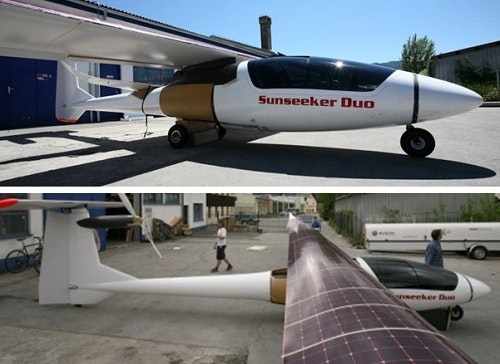
Source: Sunseeker Duo
The Sunseeker Duo has a wingspan of 23 meters (75 feet) and the propeller is driven by a 20 kW direct drive motor, with power provided by 72 lithium-polymer batteries, wired in series. Those donated batteries are not necessarily the optimal design but lithium polymer is favoured for most aircraft due to the near impossibility of leakage and the light weight of the casing required. They store enough power to allow twenty minutes of full-power climbing, and, following this, the pilot may glide while they charge. When above the clouds, the Sunseeker Duo will have the capacity to cruise on direct solar power for hours. Perhaps later versions will permit regenerative soaring like some existing pure electric (though not solar) planes.
At present, the Sunseeker Duo is still a work-in-progress, and the Sunseeker team has turned to Kickstarter to raise funds. Project leader Eric Raymond aims to make a series of flights worldwide, beginning with a circumnavigation of the Americas, with the goal of highlighting the benefits of solar technology. In addition, a documentary film crew will follow his progress and a book is also planned to document the adventure.
For more information on electric aircraft, their technologies and market forecasts see Electric Aircraft 2012-2022. Save 20% off all IDTechEx reports until the end of December - quote online DEC2012.
Also attend Electric Vehicles Land Sea & Air.
